
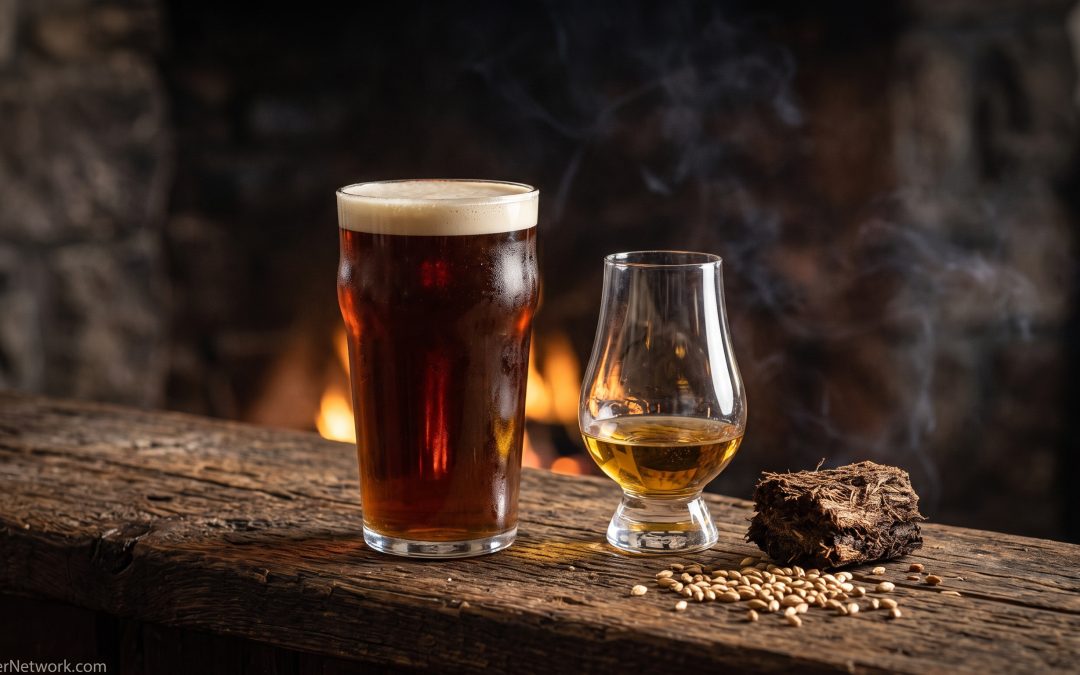
Here’s a fact that surprises many beer lovers: every bottle of malt Scotch whisky starts its life as something very close to beer. Same grain, same malting, same mashing, same yeast-driven fermentation. The paths only split when the distiller fires up the still. Once you understand that shared beginning, pairing beer and Scotch becomes one of the most rewarding tasting experiences around.
Same Grain, Different Destiny
Malt Scotch whisky is made from malted barley, water, and yeast, and nothing else. The barley is malted just as it is for beer: steeped, germinated, and dried in a kiln. Distillers then mash the malt in hot water to draw out its sugars and ferment that sweet liquid with yeast. If you’d like a refresher on that first step, our guide to malt walks through it.
According to the Scotch Whisky Experience in Edinburgh, fermentation dies down after about two days, leaving a liquid called “wash” at roughly 6 to 8% alcohol. In other words, wash is essentially a strong, unhopped beer. Brewers boil their wort with hops for bitterness and aroma. Distillers skip the hops, because they’re about to concentrate everything through distillation.
Where the Paths Split
From here, the brewer and the distiller go separate ways. The brewer conditions and packages the beer. The distiller sends the wash through copper pot stills. Difford’s Guide explains that malt whisky is usually distilled twice and occasionally three times, which concentrates the alcohol and the flavors created during fermentation. The new spirit then rests in oak casks for years. Much of the color and many of the vanilla, spice, and dried fruit flavors in Scotch come from those casks, often barrels that once held bourbon or sherry.
Smoke: The Flavor That Connects Them
The most dramatic link between beer and Scotch is smoke. Many Scotch distilleries kiln their malt over peat fires. The peat smoke soaks into the grain and carries through into the finished whisky as the smoky, medicinal, or maritime character that whisky fans call “peaty.”
Beer has its own version. In Bamberg, Germany, brewers have long kilned malt over beechwood fires to make Rauchbier. The two smokes are quite different. Peat is earthy and medicinal, while beechwood is sweeter and reminds many drinkers of smoked meat. Both come from the same idea: fire, malt, and patience. If you enjoy one, you’ll likely be curious about the other. Our profile of Aecht Schlenkerla Rauchbier is a great place to start on the beer side.
For a classic example of peat on the whisky side, Talisker from the Isle of Skye is a favorite for its smoky, peppery, sea-air character. The Scotch Noob’s review of Talisker 10 year is a friendly, approachable introduction for newcomers.
Scotch Ale: Beer’s Tribute to Scotland
Scotland’s own brewing tradition shares a lot with its whisky. Scottish ales and the strong, malty wee heavy (often sold as “Scotch ale”) are known for rich caramel, toffee, and toasted malt flavors with little hop character. That malt-forward profile makes them natural companions for a dram.
A common misconception is that traditional Scotch ales are brewed with peated malt. Most are not. Their depth comes from rich malts and long boils, not smoke. Some modern brewers do add a touch of peated malt for a whisky-like twist, so read the label if you’re curious.
How to Pair Beer and Scotch
In Scotland, a beer served alongside a whisky is affectionately known as a “hauf and a hauf,” a half pint and a half measure. The goal isn’t to drink fast. It’s to sip back and forth and let each one change how the other tastes. Here are a few pairings to try:
- Peated Islay or Skye malt with Rauchbier: Smoke meets smoke, but in two different forms. The beer’s malty sweetness softens the whisky’s medicinal edge.
- Sherry-cask Speyside malt with a wee heavy: Dried fruit, toffee, and caramel echo back and forth for a rich, dessert-like pairing.
- Light, honeyed Lowland malt with a Scottish export ale or a crisp pilsner: A gentle pairing where the beer refreshes between sips.
- Bourbon-cask Highland malt with an imperial stout: Vanilla and oak from the cask meet chocolate and coffee from the roasted malt.
- Any Scotch with a barrel-aged beer: Many breweries age strong ales and stouts in used whisky barrels. Tasting the beer next to a similar whisky shows what the barrel added.
Tips for a Beer and Scotch Tasting
- Pour small. A one-ounce dram and a small glass of beer are plenty. Whisky is around 40% ABV or higher, so moderation matters more than usual.
- Taste the beer first, then the whisky. Going from the stronger spirit to the beer can make the beer seem thin.
- Add a few drops of water to the whisky. It can open up aromas and soften the alcohol.
- Keep water and food on the table. Oatcakes, sharp cheddar, smoked salmon, and dark chocolate work beautifully with both.
Join the Conversation
Do you have a favorite beer and Scotch combination? Are you on Team Peat or Team Beechwood? Share your pairings in the comments, send us an article about your own tasting experiments, and join the network to connect with fellow beer lovers.
© 2026 by YourBeerNetwork.com All rights reserved. No part of this document may be reproduced or transmitted in any form or by any means, electronic, mechanical, photocopying, recording, or otherwise, without prior written permission.
Disclaimer: This article is for informational and entertainment purposes only. YourBeerNetwork.com is not affiliated with any distillery, brewery, or website mentioned. Whisky and strong beers contain high levels of alcohol. Please drink responsibly, never drink and drive, and only consume alcohol if you are of legal drinking age.
